about architects of well being
the gap we exist for
Ask a veterinarian why their work matters and the answer comes fast and clear. Ask how they feel at the end of the day and something else surfaces: flat, depleted, running on empty. It is hard to be excited about the work anymore.
That gap between a job that still means something and a job that drains you dry is the veterinary paradox. Not burned out. Not flourishing. Languishing in the middle. Architects of Well-Being exists for that middle group.
what we actually do
We know the six stressors that press on this profession: Demand Pressure, Emotional Load, Financial Strain, Moral Distress, Toxic Culture, and Liability Risk. Hospitals already track revenue growth and return on investment. We add the one almost nobody tracks: the well-being of the people generating those numbers.
We locate where staff actually sit on the two things that predict where a team is headed, demand pressure and engagement, and then we pull specific organizational levers to control demand and advance engagement.
By controlling demand, strengthening job and personal resources, aligning what the hospital values with what the veterinarian values, and building positive interventions into the ordinary week, we create real change in a profession where the conditions of the workday have not kept pace with what the work now asks of the people doing it.
It is not pizza parties. It is not a subscription to a meditation app. It is not wellness bingo played during a staff meeting. It is changing the conditions of the workday itself, and then measuring whether the change held. When it does not, we change something else.
Well-being is not a perk, and it does not happen on its own. It has to be deliberate. It has to be designed, built, and maintained. That is the veterinary well-being framework, and that is Architects of Well-Being.

about dr. rob santos
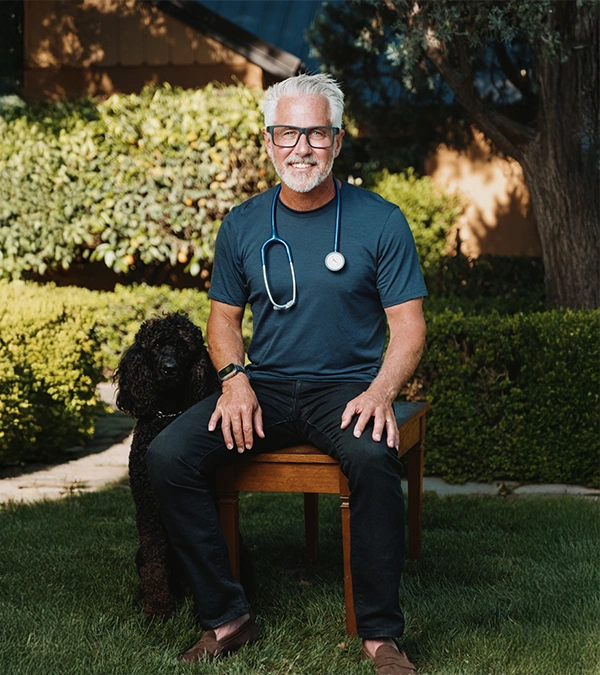
Dr. Santos was born in Turlock, a small town in California’s Central Valley, and grew up on his family’s dairy farm surrounded by cows, dogs, cats, and every other animal a farm collects. When he was about twelve, he helped a local veterinarian deliver a calf, and that moment set the course for the rest of his life. He earned his veterinary degree from Purdue University in 1991.
He bought his first practice, Community Veterinary, in 1993, and built his second, Monte Vista Small Animal Hospital, in 2003. Along the way he became certified in both acupuncture and canine rehabilitation, and he holds a Master of Business Administration from UC Davis and a Master of Applied Positive Psychology from the University of Pennsylvania, where the framework began as a capstone on the veterinarians who are neither flourishing nor in crisis.
Most people working on veterinary well-being come from one side or the other: clinicians who know the exam room but not the science, or academics who know the science but have never had to tell a family what a treatment costs. Thirty-five years in practice and two graduate degrees put Dr. Santos on both sides of that line.
He practices veterinary medicine in California and Washington, D.C.
More than thirty years later, Dr. Santos still lives on his ranch in Turlock with his wife, near their three adult children, where he raises sheep and goats. He also farms almonds, pistachios, corn, soybeans, and alfalfa. Beyond the practice, he is a partner in Roam-n-Board pet boarding, Family Pet Mortuary, and Furreka Microchips, each an extension of his lifelong commitment to animals and the people who love them.

Vision
A veterinary profession where every veterinarian and their team can flourish at work.

Mission
To move veterinarians and their teams toward flourishing by raising engagement and reducing demand pressure through the Five Organizational Levers of Motivation.
our values

creativity
Every hospital is different, and a framework applied straight out of the box fails. We design for the practice in front of us: its caseload, staffing, constraints, and history. When the standard intervention does not fit, we build one that does.

love of learning
We follow the evidence, including where it disagrees with us. We read what is published, we watch what our own data shows, and we revise the model when it needs revising. A framework that never changes is a belief system, not a science.

bravery
We tell hospital owners what the data shows, including when the answer is that the schedule is the problem, not the staff. We were not hired to confirm what a practice already believes. If the finding is uncomfortable, it still gets said out loud.
fairness
The burden of change belongs to the organization, not to the individual. We do not ask veterinarians to become more resilient in conditions that would exhaust anyone. When the work is breaking people, we fix the work.
leadership
This profession has been waiting for someone to take well-being seriously enough to build something. We went first. We hold ourselves to the same standard we set for the hospitals we serve, and we say what we mean to audiences who would rather hear something easier.
teamwork
We work alongside a hospital rather than delivering to it. Owners, veterinarians, technicians, and client-facing staff all know things we do not, and the design only works if they shape it. We stay through implementation, and we stay when it needs adjusting.